

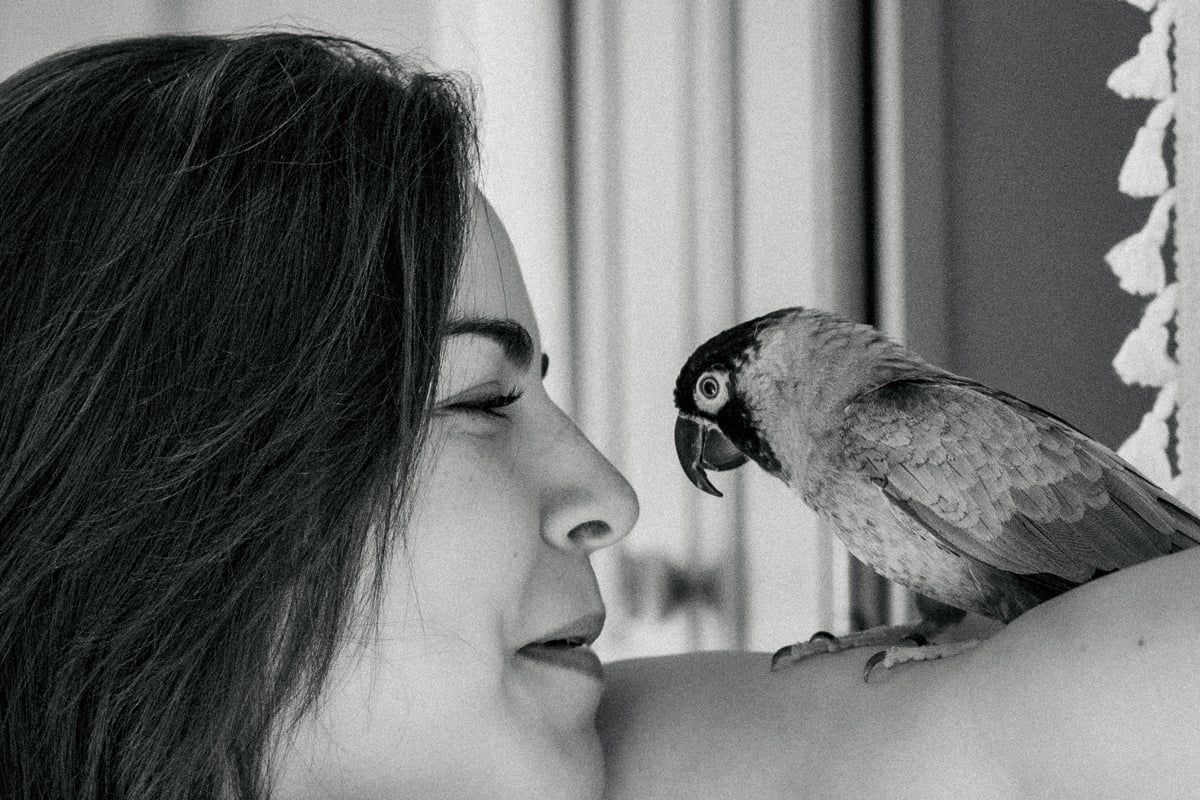
I've been thinking about this a lot lately... what if the thing that made me good at my job wasn't my license, my years of experience, or my hard-won knowledge of septic systems — but a 29 yr old Nanday conure named Newtie?
He has been with me for over 15 years. I got him from a rescue where I volunteered, back when I was learning what it meant to care for something wild that had chosen you anyway. He has a dedicated bird room with easy clean floors, his own custom tree, free flight when we are home, and an air filtration system I have calibrated over years of California wildfire seasons. He has also, through some process of evaluation I will never fully understand, claimed my blanket basket in the living room as a secondary residence. If you know, you know.
2026 has been a year of soul searching, and what I realized is that I have spent a decade walking properties and doing something I did not have a name for — reading what lives there before I read what it lists for. The water sources. The canopy. The adjacency to open space. The quality of light in the morning and what it draws.
It turns out that is a way of seeing that came from birds. From Newtie specifically, and from years of learning to pay attention to what a creature needs from a place, not just what a human does.
THE RESCUE ORIGIN STORY
Before real estate, I volunteered at a parrot rescue in high school. That is where I first understood the weight of the question: what does this animal need to actually thrive here?
Not survive. Thrive.
It is a different question than the one most people ask about houses. Most people ask: does it have enough bedrooms? Is the kitchen updated? What is the commute?
Bird people ask different questions. What is the air quality situation? Is there a room that can really be theirs? How does the light move through the house? What is adjacent? What will they be able to see and hear?
I have been asking those questions about properties for years without fully realizing that is what I was doing. I thought it was "homeowner literacy". And for a lot of it that still holds true. But it's also so much more than that.
THE MOMENT I PUT IT TOGETHER
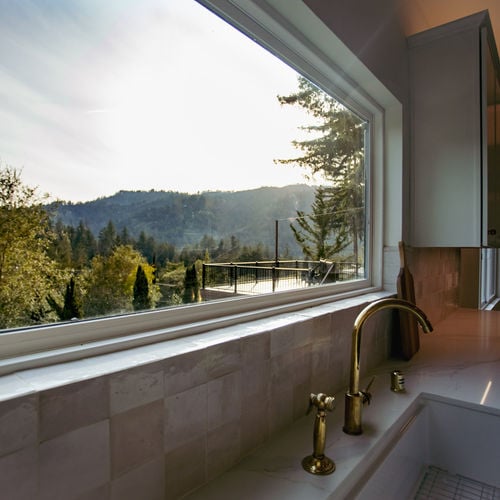
It was a showing. A conservation-minded buyer — the kind who asks what watershed the property sits in before she asks about square footage. We were walking a forested mountain property in the late afternoon, and I went quiet for a moment before I said anything.
She asked what I was looking at.
"The edge," I said. "Where the forest clears and this becomes something else. That transition is where everything interesting happens ecologically."
She looked at me. "How do you know that?"
I thought about it. "I think I learned it from my bird."
That was the first time I said it out loud. And it was true.
WHAT NEWTIE TAUGHT ME ABOUT PROPERTY
He taught me that a room is not just a room. It is a microclimate, a sightline, a territory. It can feel safe or exposed. The way light enters matters. What is visible from the primary perch matters. What sounds arrive from outside matter.
I walk into properties thinking about all of these things — for human clients, yes, but the framework came from years of thinking about them for him.
He taught me that air quality is infrastructure, not a preference. That sightlines are a form of security. That the boundary between cultivated and wild is where attention naturally wants to rest.
He taught me, more than anything, that home is not a set of features. It is a set of relationships — between a creature and its space, between that space and what surrounds it, between the life lived there and the land that holds it.
THE CLIENTS WHO FIND ME
The people who end up working with me in the avian and conservation space almost always say some version of the same thing: "I have never had an agent who understood what I was actually looking for."
One was building a flight aviary and needed a property with the right clearing, the right setbacks, the right sun exposure. One was relocating from Seattle with three macaws and a very specific list of requirements for what a livable home actually meant for her flock. One just wanted to live somewhere the Cooper's Hawks nested in the yard and nobody thought that was a strange thing to care about.
None of them had ever been able to explain this to an agent and have the agent understand it without translation.
I understood it because I live it.
WHAT THIS MEANS FOR HOW I WORK
I am not the agent for everyone. I do a am selective about the number of transactions I take on each year, I work by referral.
But if you are looking for a home where birds — your birds, or the wild ones — are part of the reason you are buying, I am probably the person you have been looking for.
It just took me a while to say so out loud.
So if that's the type of realtor you're looking for. Let's have a chat.
P.S. — Newtie has final approval on all major decisions. This has not always been convenient.
Check out this article next